
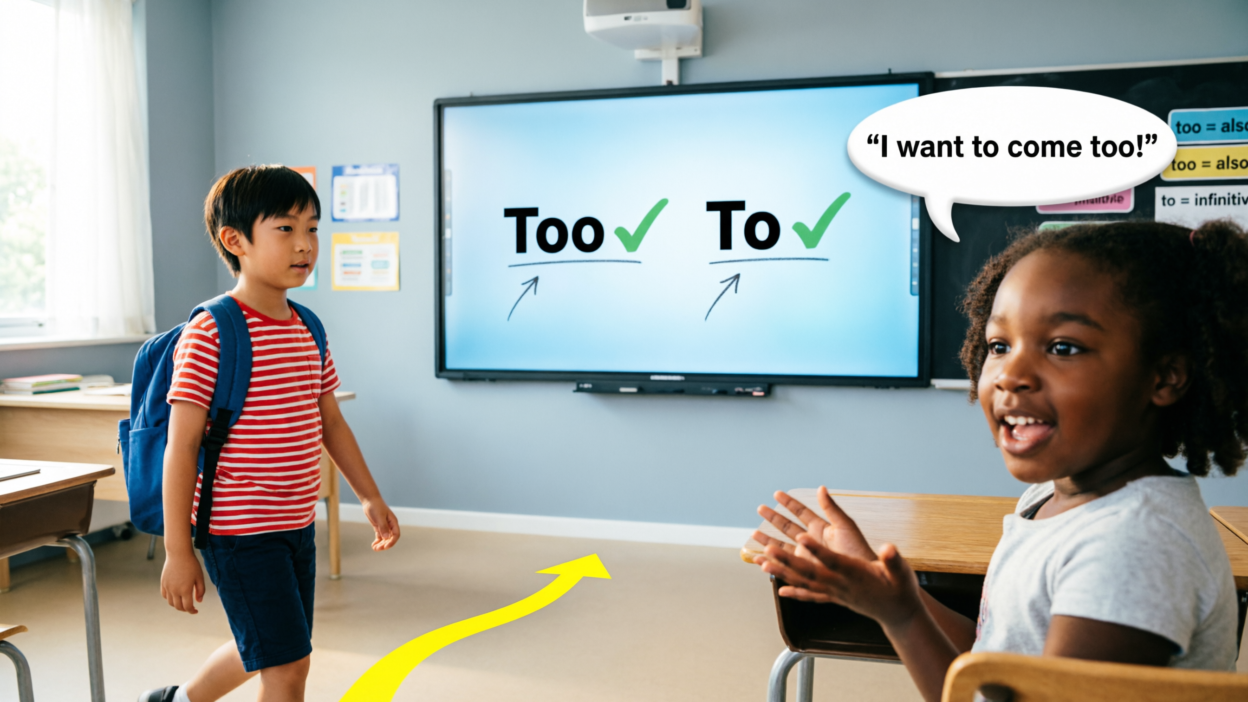
Too and to are two commonly confused English words because they sound the same. However, they have different meanings and grammatical functions. To is mainly used as a preposition or as part of an infinitive verb, while too means also or excessively.
What Does “To” Mean?
To is a preposition and is also used before the base form of a verb to create an infinitive.
Examples of “To”
• I’m going to the library.
• She wants to learn Spanish.
• Please give the book to Sarah.
• We need to leave early.
• They traveled to Japan last summer.
• He forgot to lock the door.
• The package was sent to my office.
• I like to read before bed.
• She walked to school every day.
• It’s important to stay hydrated.
What Does “Too” Mean?
Too is an adverb that means also, as well, or more than necessary.
Examples of “Too”
• I’d like to come too.
• She is too tired to continue.
• This bag is too heavy.
• They enjoyed the movie too.
• The music is too loud.
• Can I join you too?
• It’s too cold to go outside.
• He speaks French too.
• You’re working too hard.
• We were too late to catch the train.
Too vs. To: Key Differences
| To | Too |
|---|---|
| A preposition or part of an infinitive verb | An adverb meaning also or excessively |
| Shows direction, purpose, or relationship | Adds the meaning of also or more than enough |
| Example: I want to study. | Example: I want to study too. |
Common Mistakes
• ❌ I want too learn English.
• ✅ I want to learn English.
• ❌ She went too the store.
• ✅ She went to the store.
• ❌ Can I come to?
• ✅ Can I come too?
• ❌ This coffee is to hot.
• ✅ This coffee is too hot.
• ❌ He wants too travel the world.
• ✅ He wants to travel the world.
Final Thought
Although too and to sound the same, they serve different purposes in English. Use to for direction, relationships, and infinitive verbs, and use too when you mean also or more than necessary. Remember this simple trick: too has an extra “o”, just like it often means something extra.