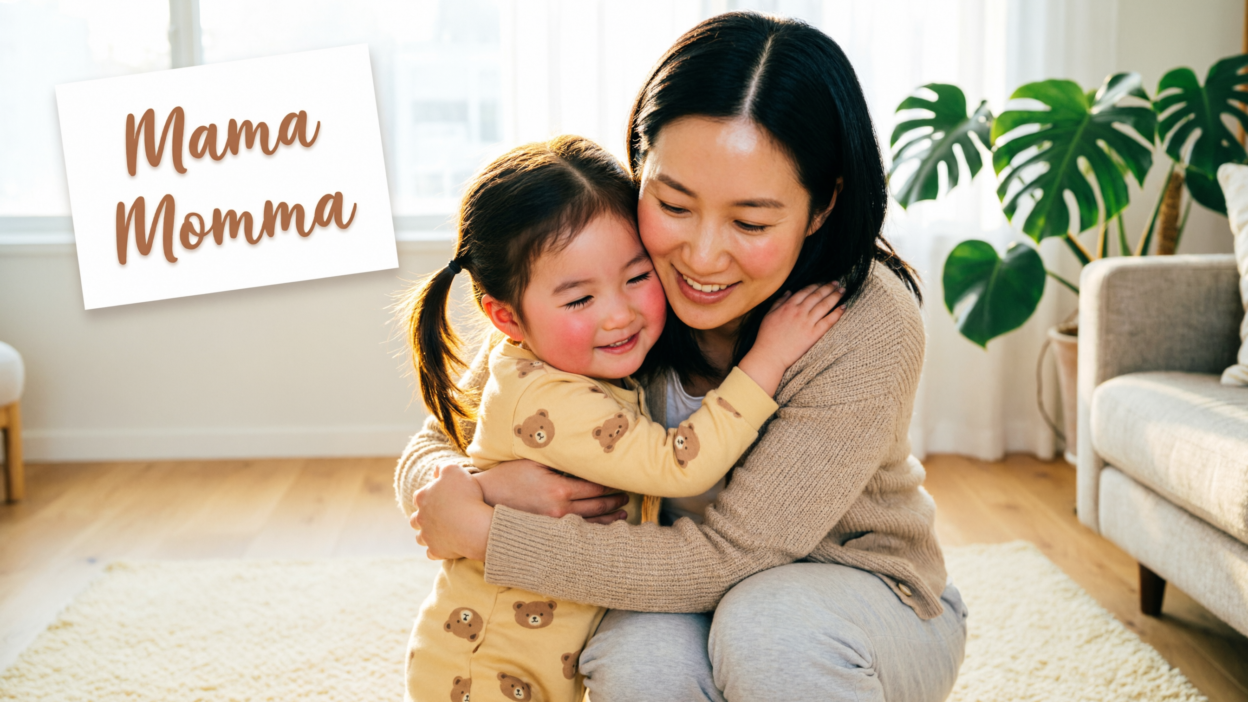
Momma and mama are both affectionate words for mother, but they differ in usage, tone, and regional preference. Mama is the more common and widely accepted spelling, while momma is an informal variation often used in American English, especially in the Southern United States.
What Does “Mama” Mean?
Mama is an informal noun used to refer to one’s mother. It is commonly used by young children and is also a term of affection used by adults.
Examples of “Mama”
• My mama always gives the best advice.
• The baby smiled when her mama picked her up.
• I called my mama after work.
• His mama taught him to be kind.
• Happy Birthday, Mama!
• The little girl ran to her mama.
• I miss my mama every day.
• Mama made my favorite meal.
• Thank you, Mama, for everything.
• My mama is my biggest supporter.
What Does “Momma” Mean?
Momma is an informal spelling of mama. It has the same meaning but is especially common in American English, particularly in Southern dialects, country music, and casual speech.
Examples of “Momma”
• My momma always knows what to say.
• Momma baked cookies for everyone.
• I learned that from my momma.
• Momma told me to be careful.
• My momma loves gardening.
• Everyone says my momma is a great cook.
• I hugged my momma before leaving.
• Momma always believed in me.
• My momma taught me good manners.
• Thanks, Momma, for your love and support.
Momma vs. Mama: Key Differences
| Mama | Momma |
|---|---|
| More common and widely accepted spelling | Informal variant, especially in American English |
| Used worldwide | Common in Southern U.S. dialects and casual speech |
| Frequently used by children and adults | Often reflects a warm, regional, or family style |
| Example: I love my mama. | Example: My momma made dinner. |
Common Mistakes
• ❌ Assuming momma is incorrect.
• ✅ Momma is a valid informal spelling, especially in American English.
• ❌ Thinking mama and momma have different meanings.
• ✅ Both refer affectionately to a mother.
• ❌ Using momma in very formal writing.
• ✅ In formal writing, mother or mom is usually more appropriate, depending on the context.
• ❌ Believing one spelling is always better.
• ✅ Choose the spelling that matches your audience, region, or personal preference.
Final Thought
Both mama and momma are correct and affectionate ways to refer to a mother. Mama is the more widely used and internationally recognized spelling, while momma is a warm, informal variant commonly found in American English, particularly in Southern speech. Choose the form that best fits your tone, audience, and style.