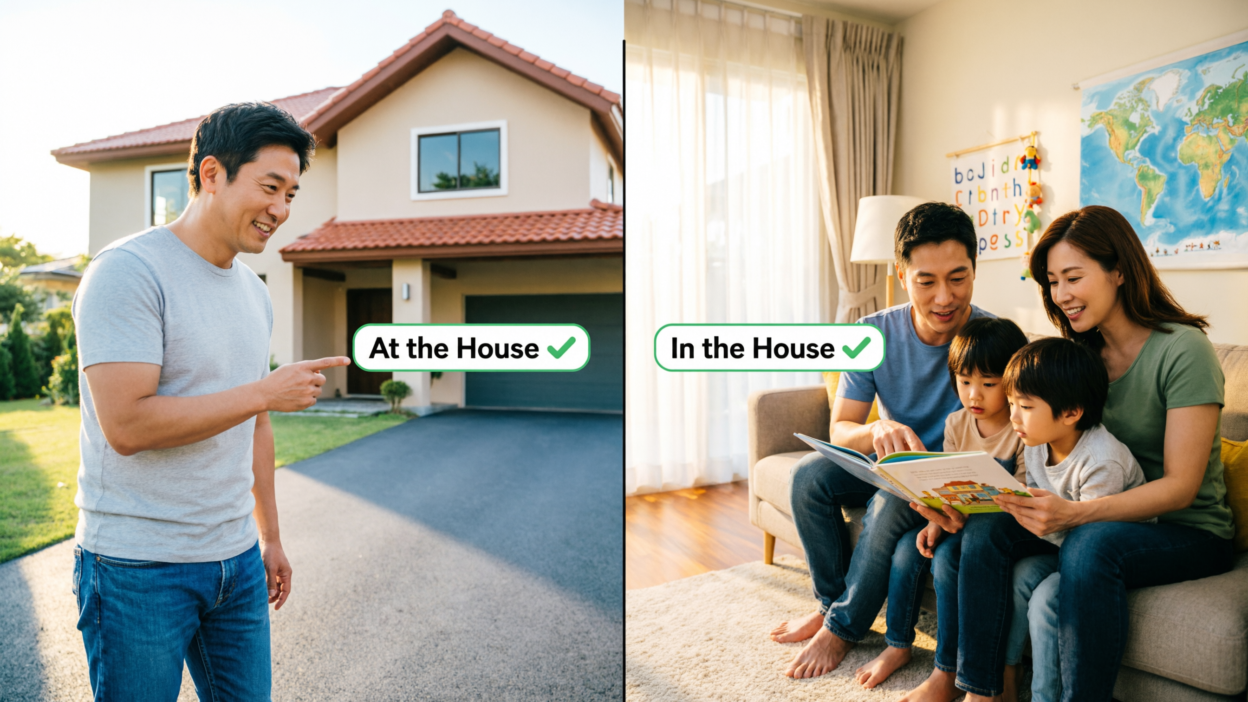
The phrases at the house and in the house are both grammatically correct, but they are used in different situations. Many English learners confuse them because both refer to a house. The difference is whether you’re talking about a location (at the house) or being inside the building (in the house).
If you’ve ever wondered whether to say I’m at the house or I’m in the house, this guide explains the difference with simple definitions, grammar rules, examples, comparison tables, common mistakes, and memory tricks.
Quick Answer
At the house means at the location of the house. It focuses on where someone is generally. In the house means inside the house. It specifically refers to being within the building.
Why People Confuse It
People often confuse these phrases because:
- Both refer to the same place.
- The prepositions at and in both describe location.
- In some situations, either phrase can be correct.
- Different contexts require different prepositions.
- Native speakers use both naturally.
The easiest way to remember is:
- At = Location
- In = Inside
What Does “At the House” Mean?
At the house means at the location or property of the house. It doesn’t necessarily mean the person is inside. They could be in the yard, driveway, porch, or simply at that address.
Examples of “At the House”
- I’m at the house waiting for you.
- She’s at the house with the movers.
- We met at the house before the party.
- The plumber arrived at the house early.
- Everyone is at the house already.
- I’ll be at the house all afternoon.
- They gathered at the house before leaving.
- The delivery driver is at the house now.
- He stayed at the house while we were away.
- Meet me at the house after work.
What Does “In the House” Mean?
In the house means inside the building. It emphasizes that someone or something is physically within the house.
Examples of “In the House”
- I’m in the house because it’s raining.
- The kids are in the house watching TV.
- There’s nobody in the house.
- She left her keys in the house.
- We spent the evening in the house.
- The dog is in the house.
- Everyone stayed in the house during the storm.
- He heard a strange noise in the house.
- There are five bedrooms in the house.
- Please don’t run in the house.
At the House vs. In the House Comparison
| Feature | At the House | In the House |
|---|---|---|
| Meaning | At the property’s location | Inside the building |
| Focus | General location | Physical position indoors |
| Refers To | Address or property | Interior of the house |
| Example | I’m at the house. | I’m in the house. |
When to Use Each
Use at the house when:
- Referring to someone’s location generally.
- Talking about arriving at a home.
- Mentioning a meeting place.
- Referring to the property or address.
Use in the house when:
- Talking about being indoors.
- Describing activities inside the home.
- Referring to objects inside the building.
- Talking about rooms or interior spaces.
Examples (10+)
- I’ll meet you at the house at 6 p.m.
- They’re waiting at the house.
- The electrician is at the house now.
- We arrived at the house before sunset.
- Everyone gathered at the house for dinner.
- The children are in the house playing games.
- My phone is in the house.
- Nobody was in the house when I arrived.
- She remained in the house all day.
- We found the cat in the house.
- The lights were on in the house.
- He stayed at the house, but most of the time he was in the house working.
Common Mistakes
❌ I’m at the house watching TV in the living room.
✅ I’m in the house watching TV in the living room.
❌ The keys are at the house on the kitchen table.
✅ The keys are in the house on the kitchen table.
❌ Meet me in the house at 5 p.m. (when referring to the meeting location generally)
✅ Meet me at the house at 5 p.m.
❌ The dog is at the house sleeping in the bedroom.
✅ The dog is in the house sleeping in the bedroom.
❌ Everyone is in the house waiting outside.
✅ Everyone is at the house waiting outside.
Memory Trick
Remember:
- At = Address or Location
- In = Inside
Ask yourself:
- Where is the person generally? → At the house
- Are they physically inside? → In the house
American vs. British English
There is no major difference between American and British English.
Both varieties use:
- At the house for the general location.
- In the house for being inside the building.
Similar Words
Other commonly confused preposition pairs include:
- At home vs. In the home
- At school vs. In school
- At work vs. In the office
- At the office vs. In the office
- At the hospital vs. In the hospital
- At the airport vs. In the airport
- On the bus vs. In the bus
- At the store vs. In the store
Final Verdict
Both at the house and in the house are correct, but they have different meanings. At the house refers to being at the property’s location, while in the house means being physically inside the building. Choosing the right phrase depends on whether you’re emphasizing the location or the interior.
Remember This
At the house = Location
In the house = Inside
If you’re talking about where someone is, use at the house. If you’re talking about being indoors, use in the house.
Frequently Asked Questions
Is “at the house” correct?
Yes. It refers to being at the location or property.
Is “in the house” correct?
Yes. It means inside the building.
Which is more common?
Both are common, but they are used in different contexts.
Can I say “I’m at the house”?
Yes. It means you’re at that location, though not necessarily inside.
Can I say “I’m in the house”?
Yes. It means you’re physically inside the house.
Do American and British English use these differently?
No. The usage is essentially the same in both.
Conclusion
Although at the house and in the house seem similar, they describe different ideas. At the house focuses on the general location or property, while in the house emphasizes being inside the building. Understanding this distinction will help you choose the correct expression in everyday conversations and writing.
Whenever you’re unsure, think about whether you’re describing the location or the interior. That simple question will usually point you to the right phrase.